More than mints: How hotel brands are driving bookings with AI and personalization

Joff Romoff
Global Market Lead for Travel & Hospitality
Lacey Duncan
Global Content Lead, Travel & Hospitality
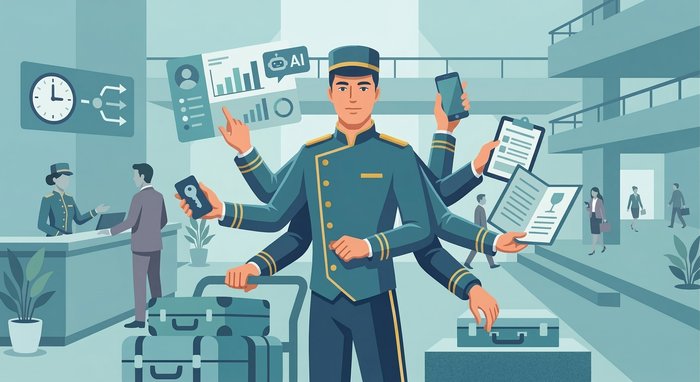
Moving beyond service, AI gives hotel teams the speed and insight to make every guest feel like the only guest in the building.
What does it actually take to run a hotel brand today?
Ask the revenue team and they'll tell you it's watching a conference get announced in Nashville and having to reprice those properties before the demand spike hits. Ask marketing and it's figuring out how to win the traveler who has your property open in one of six browser tabs, right next to a competitor offering a lower rate. Ask guest services and it's smoothly handling a 2 AM message from a guest in Barcelona asking about late checkout — in Catalan.
Every team has its own pressures, but they're all working on some version of the same problem: How do you move faster, use your data better, and make the experience feel personal to the guest? How can you reach digitally native travelers who are so diffuse and distinct in their travel planning and travel needs? And how to do all this without doubling your team?
AI and cloud tools are starting to answer these questions in very practical ways. Google Cloud, alongside Search, YouTube, and Maps, is helping hotel brands work smarter across marketing, revenue, loyalty programs, guest experience, and operations.
Here's how some of the biggest names in hospitality are putting these tools to work. (And they're not alone. For hotel owners looking for more ideas on how to make cloud, AI, and other digital tools work for their properties and franchises, check out our companion article.)
Driving bookings
Hotels can strengthen their digital presence and attract travelers by combining Google's marketing tools with AI. This approach helps deliver real-time information to potential guests while responding quickly to market shifts.
To get the most from their marketing, hotels can use their Google Business Profile to showcase details, amenities, and photos on Google Search and Maps. From there, free booking links display real-time rates and availability, sending customers directly to the hotel’s website. Google Hotel Ads let hotels promote their profile and reach specific audiences. AI-powered tools like Performance Max pull signals from Google Search and YouTube to serve relevant ads and adjust bidding strategies based on market trends in real time.
For example, when a major event is announced and travelers start searching for nearby hotels, AI can quickly create and serve ads highlighting a hotel’s proximity to that event. Some people call this the “Taylor Swift” effect.
See how Hilton Hotels uses AI-powered Search and YouTube to connect with “zillennial” travelers, transforming their digital discovery into direct bookings

To enhance the guest experience, hotels can use Google Cloud's Vertex AI and Gemini models to create digital concierges. These AI-powered agents support both guests and staff around the clock, handling everything from answering questions to managing bookings and reservations. Because these agents are built on a hotel’s own unified data, they can answer questions specific to that property and brand Big Query together with Vertex AI lets hotels combine structured and unstructured data for real-time decisions — for example, using a photo or video as input to a shopping query.
Watch how Radisson Hotel Group makes every moment matter with multilingual customer experiences

Creating and capturing brand loyalty
Today's travelers choose brands that simplify their experience and earn trust. Using Google Cloud’s data analytics tools, hotels can bring together structured and unstructured data to build a single, detailed view of each guest. This provides the foundation for building personalized loyalty programs and crafting "experience-led rewards" that go beyond point systems.
Hotels can use tools like Gemini, Vertex AI, and Big Query to tailor offers — exclusive discounts, room upgrades, etc. — to each guest’s preferences and history. This customized engagement can boost loyalty program sign-ups and the all important share of wallet and lifetime value revenues that allow hotels to save marketing dollars in having to acquire new guests..
Hotels can also pair these tools with Dialogflow (rebranded Conversational Agents, Sept. 2025), to build an AI concierge that handles inquiries, bookings, and experiences, all tailored to the individual guest.
Juan Campins, vice president of Digital Channels at RIU Hotels & Resorts, discussing how RIU uses an AI chatbot built on Google Cloud to provide a superior guest experience and increase direct bookings:
We are advancing towards a personalised digital experience in real time. We want this personalisation to be multi-channel, based on customer knowledge, the use of data and the application of AI.
Streamlined and engaging booking
As travelers move from browsing to booking, hotels need a smooth path that converts interest into confirmed reservations. A digital concierge powered by advanced conversational AI can assist travelers at every stage, allowing the guest to shop in their natural language, answering specific questions about amenities, providing personalized recommendations for local activities, and helping to book personalized excursions. This approach simplifies booking while building a stronger relationship with the guest and driving additional revenues for the hotel. Natural language interactions also help hotels pick up on traveler intent in real-time, improving conversion and providing more authentic and individualized marketing.
Hotels can also improve the accuracy of their conversion tracking with Google Enhanced Conversion tools, which help them capture first-party data securely and get more from their campaigns. The system uses a secure hashing algorithm to match a customer's details to their Google account, even without relying on cookies, giving hotels better data for campaign performance and return on investment.
Hotels can use Gemini models and Vertex AI to create conversational AI agents that act as a digital concierge, providing 24/7 support and enhancing the guest experience. These AI agents can be deployed across various channels like a hotel's website, mobile app, messaging platforms to handle a wide range of requests and interactions. These agents handle routine tasks, freeing up staff to focus on complex guests needs and more personalized service.
Lukas Karrer, director of Direct Business at Hotelplan Suisse explains how gen AI helps share expert travel advice and continually gets better along the way:
Any questions that stump the chatbot are escalated to our travel experts, who now have more time to respond in detail. Those answers are then fed back into the model, creating a feedback loop to continually improve responses.
Dynamic pricing
Hotels can grow revenue by adopting AI-powered dynamic pricing. Using BigQuery to unify their data and Vertex AI to build predictive models, they can forecast demand and recommend optimal room rates. These models analyze data in real-time, including holiday booking trends and competitor pricing, to recommend and automatically adjust room rates. This helps hotels grow revenue during peak periods like holidays and major local events.
This continuous analysis helps hotels respond to demand shifts, capture revenue during spikes, and keep rates competitive when markets move quickly. The system can also adjust pricing for different customer segments based on their behavior and preferences.
Running a hotel brand today isn’t about choosing between cutting-edge tech and classic hospitality. It’s about using one to enable the other. By leaning into AI and cloud-driven insights, brands aren't just "moving faster"; they’re clearing the administrative noise and providing guests what they want, when they want it so their teams can get back to what they do best: making every guest feel like the only guest in the building.