Calling the game: How MLB brings AI-powered color commentary to fans with Scout Insights

Matt Graser
Director, Engineering, MLB
Josh Frost
SVP, Product, MLB
Using a suite of AI and cloud tools and decades of league data, Scout Insights powered by Google Cloud is able to deliver relevant commentary that feels real-time — part of the magic of the system’s design.
Major League Baseball is famous for its colorful announcers. Now, MLB is bringing more color straight to your pocket, and Gemini is helping give it a voice.
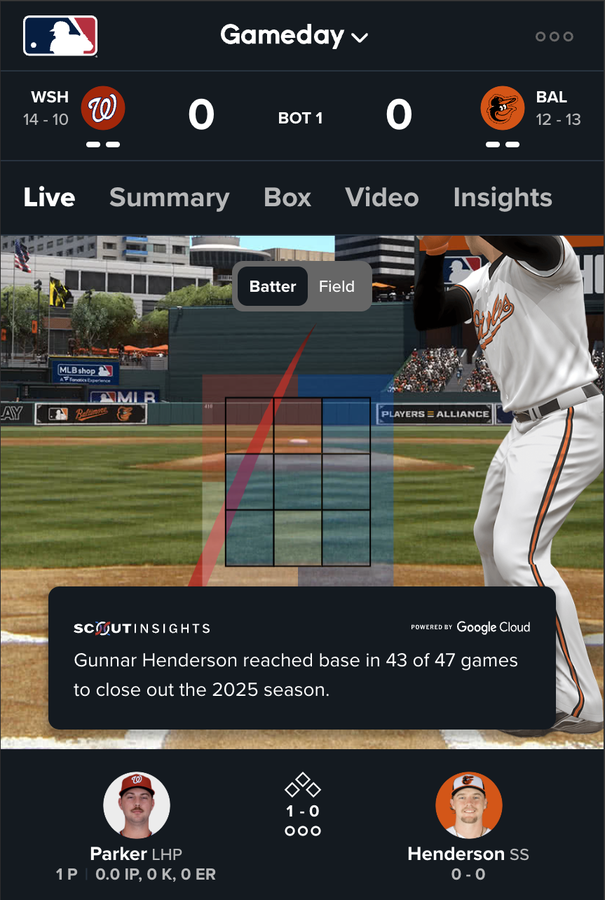
During the season, millions of fans log onto the MLB app and tap over to Gameday, a hallmark feature for up-to-the-pitch action across more than a dozen live games each day. Given the sport’s century of tradition, 162-game regular season, and global reach, baseball fans are some of the most sophisticated and engaged out there. This Wednesday, for the state of the season, we’re launching MLB Scout Insights in Gameday, so we can bring fans even more immersive detail from every inning of every game all season long.
This audacious project requires a scale, speed, and complexity that only the cloud and AI can deliver.
Built with Google’s Gemini models, Scout Insights scans the entire history of Major League Baseball's traditional and statcast data nearly as fast as a Cy Young winner’s four-seamer. The tool then cross-references all that data with situational game scenarios, and then delivers game-relevant context at key points throughout the 15 or so games taking place each day.
Here’s one example that we enjoyed from our Spring Training testing: “Trevor Rogers stifled left-handed batters in 2025, holding them to a .159/.224/.201 slash line across 78 PA,” short for plate appearances.
With Scout Insights, every fan can feel like the smartest person in the stands, at the water cooler, or on the couch. It’s about deepening connections to the game, and sharing that passion with others. That’s the magic of sports, and we’re making more of it possible with the magic of AI.
Scout Insights, from the stands to your hands
Fans want to be smart and insightful, but it used to take years of watching the game or working the broadcast booth to hone that kind of knowledge. Now, we can do it in seconds with cloud and AI tools.
MLB has spent years working with Google Cloud to build massive databases, data lakes, and the MLB Film Room digital archive, which together serve as the foundation for advanced digital tools and programs within the MLB organization, as well as for teams and media partners.

The new Scout Insights feature shown on the desktop version of Gameday.
Now that we can bring Google’s latest AI models onto the bench, it’s unlocked clever tidbits of commentary for Scout Insights (as well as other projects in the works).
Here’s a few more of my favorite examples from our internal testing, which has run from the playoffs right through spring training — AI needs practice, too:
- Unique match-ups: Josh Bell (Irving, TX) and Bryce Elder (Decatur, TX) were born 47 miles apart.
- Physical feats: Myles Straw has never been on the injured list across 9 MLB seasons.
- Player profiles: Garret Mitchell attended Orange Lutheran HS (CA), also home to Cy Young-winner Gerrit Cole.
- Situational anomalies: Ezequiel Duran was an aggressive first-pitch swinger in 2025, swinging at 43.8% across 219 PA (MLB avg: 31.9%).
Like a 6-4-3 double play, developing the system to deliver these insights was as much art and experience as science. We chose the Gemini 2.5 Flash and Gemma models for their speed and flexibility, and we needed to tune the AI so the models could register exactly what details fans would appreciate, versus what felt totally out of left field, so to speak.
The art of "surprisal"
Building this tool meant answering a rather squishy question: What makes an insight actually insightful, rather than just an accurate fact?
One of the engineers on our team determined that a truly great insight can be thought of as an anomaly. It’s something unexpected or truly exceptional, but it can’t be so abstract as to seem weird or unimportant.
As with many AI projects, it took a good amount of manual work on the front end to capture this nuance and translate it in a way that made sense in the context of an AI model. After discussing multiple approaches, we settled on a concept called “surprisal.” In a sense, it’s a mathematical measure of language for cleverness. We calculated a rather complex surprisal ranking system to define, index, and sort the most appropriate comments, which helps the Scout Insight model understand the best responses for each game scenario.
We also had to spend time tuning the AI's personality. During our early testing, it would sometimes provide perfectly accurate player bio information, but the timing or delivery felt off. We really had to hone not only what was interesting, but when it was relevant rather than a distraction. We even briefly toyed with the idea of giving the AI a wacky personality or a specific name — maybe something in the spirit of those legendary broadcasters.
However, we quickly realized that fans rely on Gameday as the official, canonical source of truth for the game. If they want to know if a pitch was officially a ball or a strike, or if a play was a hit or an error, they check our app. Because of that trust, the tone can be fun and playful, but never too silly.
Striking out latency
When it comes to Gameday, our fans' No. 1 feature request is simple: low latency. The experience has to be as close to live as possible.
For this very reason, we’ve spent years working with Google Cloud to optimize our infrastructure to be as efficient and stable as possible. These wins are some of our proudest accomplishments.
We knew we couldn’t sacrifice any of Gameday’s responsiveness in deploying Scout Insights, but as anyone who’s used gen AI knows, queries, especially detailed ones, can take some time to spin up. During development, we found that inferencing the model in real time was taking too long. And when an insight isn’t delivered alongside the live play-by-play, it loses its impact and relevance.
To solve this, our team created a novel architecture using BigQuery, AlloyDB, and Gemini. Instead of relying on a runtime query to occur, the system anticipates game events based on the day's lineups and pre-generates the insights slightly in advance. Then, within about two seconds, it matches the current game context to the best pre-generated insight, ensuring there is absolutely no drag on the live play-by-play delivery.
We were able to overcome such hurdles and move incredibly fast because, for the first time in our six-season partnership, Google Cloud engineers embedded directly with our MLB engineering team.
The ultimate matchup: AI and fandom
Even on MLB digital and mobile platforms, we want to get closer to the essence of baseball, which for a lot of fans (us included) is that the direct matchup between the pitcher and batter. This competition develops over multiple at-bats in a game and multiple meetings across the season. Each side is learning and reacting to each other constantly.
We’re using Gemini to showcase that drama in Gameday. When you watch the at-bats on your device, you’re getting the back-and-forth of the action, and Scout Insights now lets us bring in more of the personality of these matchups, too. What was the outcome of this duo’s last match–up, and also who are they as people on and off the field?
In a sense, the same way a pitcher and batter develop a relationship over time, the same is true of Gameday, Gemini, and Scout Insights. With the compounding experience of game data and user insights, the system can learn and improve automatically.
At the end of the day, we want to help fans better connect with the game, and with each other. That connection is what the best sports, and the best technology, are all about.
Major League Baseball trademarks and copyrights are used with permission of Major League Baseball. Visit MLB.com.